Fertilisation - the first steps
Fertilisation or 'conception' is when gametes fuse to create a new organism, or more specifically for humans: when the nucleus from a spermatozoon fuses with the nucleus of the ovum to form a complete diploid zygote. Spermatozoa and ova are the male and female gametes, respectively but are usually referred to as sperm and egg.
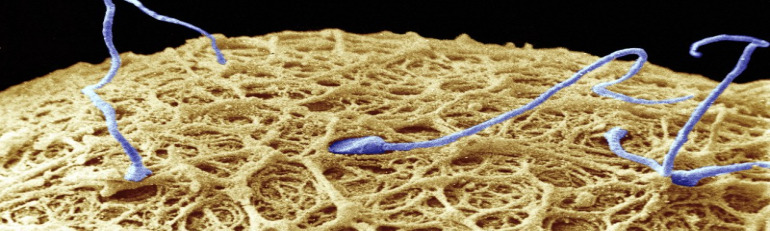
In order for fertilisation to occur, the sperm must meet an egg. The sperm is deployed into the woman during sexual intercourse and it must then traverse from the top of the vagina, through the cervix, through the uterus, to meet the egg in the fallopian tubes. Sperm have long tails, which they use to propel themselves along this long journey. The cervix can descend and the uterus contracts during female orgasm, which is not essential for conception but these are two physiological events which improve the sperm's chances of reaching the egg.
Sperm reaches the fallopian tubes in 5 to 10 minutes after ejaculation, however the sperm remain unable to fertilise the egg for approximately 10 hours.
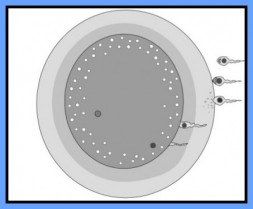
During the migration of the sperm towards the egg Capacitation occurs. This makes it possible for the sperm to penetrate an egg. Sperm possess an acrosome, which is a capsule of enzymes in the sperm head tip. These enzymes are stored for the purpose of breaking down the ovum's protective outer layers. Originally the plasma membrane of the sperm is toughened with cholesterol, which prevents early release of the acrosomal enzymes and thus enzymatic damage cannot ensue. Fluid in the female reproductive tract removes some of the membrane cholesterol and helps to dilute some of the inhibitory factors of the semen. Consequently this makes the sperm head membrane increase in permeability to calcium ions and the diffusion of these into the sperm causes the power of tail lashing to become amplified. This results in the sperm being more powerful and thus having more potential to reach the egg.
The egg needs to be fertilised between 12 – 24 hours after ovulation. However the egg does not reach the uterus for 72 hours therefore fertilisation usually occurs in the distal third (ampulla) of the fallopian tube ie. this is where the successful sperm meet the egg.
NB: post ejaculation sperm is viable for around 6 days.
Image taken from https://www.flickr.com/photos/biologyflashcards/3439550692/in/set-72157616632246017/ under creative commons licence